If you have received a text containing “LMO”, you may have wondered what the person actually meant.
Short forms are everywhere in online conversations, and people often use them to save time, keep messages casual, or express a feeling quickly.
The LMO meaning in text usually depends on the conversation around it. In casual messaging, LMO can be used as a short form for “Leave Me Alone.”
It may show that someone wants some space or does not want to continue a conversation at that moment.
However, LMO is not limited to texting. The same three letters can represent different terms in technical, medical, scientific, aviation, or professional settings.
That is why looking at the surrounding words is important before deciding what LMO means.
This guide explains the common meaning of LMO in text messages, WhatsApp, Instagram, TikTok, and dating apps.
It also explores less common meanings in specialized fields, common misunderstandings, similar abbreviations, and natural ways to respond.
Meaning & Definition LMO
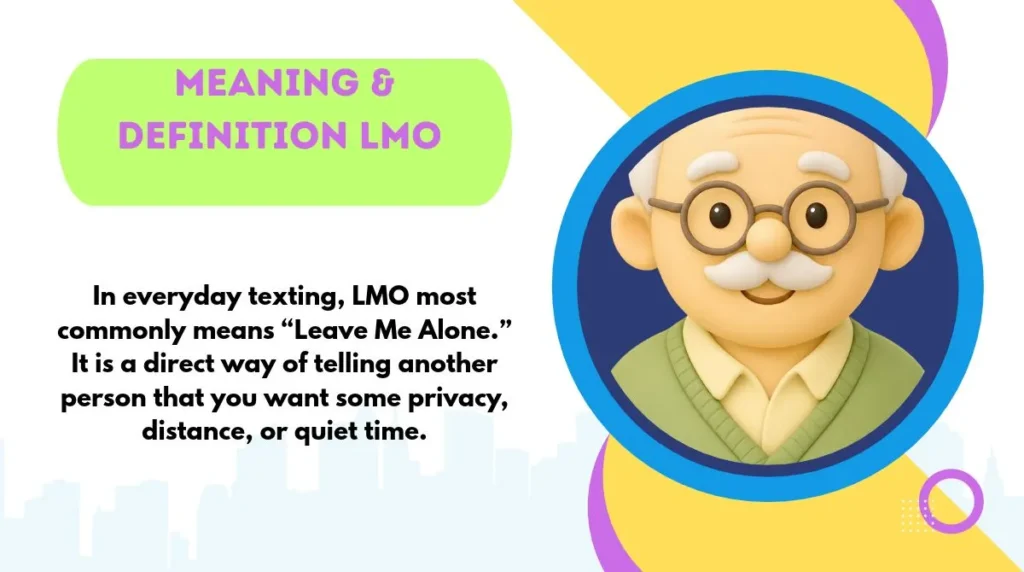
In everyday texting, LMO most commonly means “Leave Me Alone.” It is a direct way of telling another person that you want some privacy, distance, or quiet time.
For example, someone might write:
“I’m tired right now, LMO.”
In this situation, the person is probably asking the other person to stop messaging them for a while.
The tone can vary greatly depending on the conversation. LMO may sound serious, irritated, playful, or simply tired. The letters themselves do not tell you exactly how the person feels.
Consider these examples:
“LMO for five minutes, I need to finish this.”
Here, the message sounds temporary and practical.
“Please LMO. I don’t want to talk.”
This sounds much more serious.
Because text messages do not include facial expressions or voice tone, the same abbreviation can be interpreted differently by different people.
There is also an important spelling issue. Some people may use LMO when they actually intend another abbreviation, especially when typing quickly. That means context should always come first.
If someone sends only “LMO” without any other information, the safest interpretation in a casual conversation is usually “Leave Me Alone.”
However, if the conversation is about medicine, aviation, science, technology, or another specialized subject, the abbreviation may have a completely different meaning.
This is one reason abbreviations can sometimes create confusion. Three letters can carry one meaning in a group chat and another meaning in a professional document.
The best approach is simple: look at the surrounding message before deciding what LMO means.
Background
Texting abbreviations became popular because people wanted faster ways to communicate. Early text messaging had practical limitations, and shorter messages were often easier to type.
As texting moved into social media, instant messaging, and mobile apps, abbreviations became part of everyday online language.
People began using short forms for common expressions, emotions, reactions, and instructions. Some became widely recognized, while others remained limited to particular communities.
LMO belongs to the group of abbreviations whose meaning depends heavily on context.
When used as “Leave Me Alone,” the phrase itself is much longer than the three-letter abbreviation. Typing LMO can make a message shorter and more direct.
Online communication also tends to remove some of the social cues found in face-to-face conversations.
When someone says “leave me alone” in person, their voice and body language help explain whether they are joking, annoyed, or genuinely upset.
A message containing LMO does not provide those clues.
As a result, the abbreviation can sometimes appear harsher than the sender intended.
Another reason for confusion is that online language changes quickly.
New abbreviations appear through social media, gaming communities, group chats, memes, and private conversations. Not every abbreviation has one universal definition.
This is especially important when you see LMO outside ordinary texting.
A technical document might use LMO as an acronym for a completely unrelated term. In such cases, interpreting it as “Leave Me Alone” would make no sense.
Therefore, the background of an abbreviation is not always tied to internet slang. Some acronyms existed in professional language long before people started using them in text messages.
The safest habit is to separate slang meanings from technical meanings.
If you are chatting with a friend, the casual texting meaning may be the right one.
If you are reading a scientific paper, medical note, aviation document, or workplace report, you should check the terminology used in that particular field.
Usage in Different Contexts
The way LMO is understood can change depending on where it appears.
In casual chat, LMO may communicate a request for personal space. The sender may be annoyed, busy, tired, or simply looking for a break from the conversation.
On social media, abbreviations can be even more flexible. Users sometimes create their own shorthand or use abbreviations in captions and comments without explaining them.
A person who already knows the abbreviation may understand it immediately, while another reader may have no idea what it means.
In a professional setting, you should be more careful.
Using unexplained slang such as LMO in a formal email may confuse the recipient. Professional communication generally works better when important instructions are written clearly.
For example, instead of sending a coworker “LMO”, you could say that you need some time to focus on a task or would prefer not to be disturbed.
This removes uncertainty.
In education, technical writing, medicine, science, and aviation, acronyms are often created to represent long terms. These abbreviations may be recognized by specialists but unfamiliar to ordinary readers.
That means the same three letters can have completely different meanings in different communities.
Context can usually be identified through nearby words.
If you see LMO beside words about messaging, friends, arguments, relationships, or social media, a slang interpretation is more likely.
If it appears next to scientific measurements, medical terminology, aircraft information, engineering terms, or formal documentation, it may be an acronym from that field.
This distinction is especially useful when searching for an abbreviation online. A search result may show several definitions, but the first result is not necessarily the correct one for your situation.
The surrounding sentence is often more useful than the abbreviation by itself.
Meaning in Chat, WhatsApp, Instagram, and TikTok
On WhatsApp, LMO can appear during personal conversations when someone wants the other person to stop messaging for a while.
For example:
“I have a headache, LMO for a bit.”
The intended message is clear: the person wants some quiet time.
On Instagram, the abbreviation might appear in direct messages, comments, or casual conversations. Because Instagram communication is usually informal, short forms are common.
TikTok conversations can be even more unpredictable because users often develop community-specific language. A person may use an abbreviation differently from how another group uses it.
This is why you should not automatically assume every three-letter abbreviation has one fixed definition.
The LMO meaning in chat is generally easier to understand when you look at the emotional situation.
If two people are arguing and one writes LMO, it may be a firm request to stop the conversation.
If friends are joking around, the same letters could potentially be used in a playful way.
Tone matters.
For example:
“Bro 😂 LMO, I’m trying to study.”
This could sound lighthearted.
But:
“LMO. I’m done talking.”
This clearly sounds more serious.
Emoji use can also change the feeling of a message. A laughing emoji may soften a statement, while a period after a short abbreviation can make it appear more firm.
Still, you should avoid assuming someone’s emotions solely from an abbreviation.
If you are unsure, asking politely is better than creating an unnecessary misunderstanding.
A simple response such as “Sure, I’ll give you some space” is usually appropriate when the meaning appears to be “Leave Me Alone.”
Meaning in Physics, Medical, and Aircraft Terminology
LMO can also appear as an acronym in specialized fields. In these situations, interpreting it as a texting abbreviation may be incorrect.
Physics and science
Scientific fields use many abbreviations for concepts, materials, models, measurements, and organizations. The exact meaning of LMO depends on the subject and source.
In materials science and chemistry-related discussions, LMO can refer to lithium manganese oxide, a material associated with lithium-ion battery chemistry.
The abbreviation is used in technical discussions about battery materials and related technologies.
This meaning has nothing to do with texting.
A sentence discussing batteries, electrodes, energy storage, or chemical composition provides a strong clue that LMO is being used scientifically.
Medical terminology
Medical abbreviations are particularly context-sensitive. Healthcare professionals use large numbers of shortened terms, and the same abbreviation can sometimes have more than one interpretation.
LMO may appear in medical or healthcare-related documents as part of a specialized abbreviation, but its exact expansion depends on the medical field, document, institution, and surrounding terminology.
Because medical communication can affect important decisions, you should never guess the meaning of an unfamiliar medical abbreviation.
If you see LMO in a medical report, ask the healthcare professional or check the official terminology associated with that report.
Aircraft and aviation
Aviation also uses many abbreviations for aircraft systems, procedures, locations, organizations, and operational concepts.
An LMO appearing in an aviation document should therefore be interpreted according to the aviation context rather than ordinary internet slang.
For example, if the surrounding text discusses aircraft operations, flight procedures, navigation, airports, or aviation systems, the abbreviation is likely connected to that specialized context.
The main lesson is simple:
LMO does not have one universal meaning.
In a casual text, “Leave Me Alone” may be the most likely interpretation. In a technical document, the correct meaning could be completely different.
Common Misconceptions
One common misconception is that LMO always means “Leave Me Alone.”
That is usually a reasonable interpretation in casual texting, but it is not a universal rule.
Another misconception is that every person uses abbreviations in exactly the same way. Online language is flexible, and people sometimes invent personal shorthand.
Someone may also confuse LMO with other three-letter abbreviations that look similar.
This can happen especially when messages are typed quickly on a phone.
Another mistake is assuming that LMO automatically means the sender is angry.
That is not necessarily true.
A person could be tired, busy, distracted, overwhelmed, or simply asking for a few minutes of privacy.
The surrounding conversation matters.
For example:
“LMO, I have an exam tomorrow.”
This may be a straightforward request for quiet.
By contrast:
“LMO. Don’t message me again.”
This carries a much stronger tone.
A further misconception is that technical uses of LMO must somehow be connected to the texting definition. They do not need to be connected at all.
Acronyms often develop independently in different fields.
The best way to avoid confusion is to identify the context, audience, and subject before deciding what the abbreviation means.
Similar Terms & Alternatives
Several abbreviations and phrases may appear similar to LMO, but they do not necessarily mean the same thing.
Leave me alone is the direct phrase most commonly associated with LMO in casual messaging.
Give me some space has a similar meaning but usually sounds softer.
I need some time can communicate a temporary need for privacy without sounding confrontational.
BRB, meaning “be right back,” is different because it usually indicates that someone is temporarily leaving the conversation and plans to return.
GTG, commonly understood as “got to go,” also signals that someone is leaving, but it does not necessarily mean they want to be left alone.
AFK, or “away from keyboard,” is frequently used in gaming and online communities. It generally means the person is temporarily unavailable rather than asking others to stop contacting them.
IDC, meaning “I don’t care,” expresses a different attitude.
These differences matter because abbreviations can look similar while communicating very different intentions.
If someone says LMO, responding with the wrong interpretation can make the conversation awkward.
When you are unsure, consider the full sentence instead of focusing only on the abbreviation.
How to Respond to LMO
Your response should depend on the tone of the conversation.
If someone clearly means “Leave Me Alone,” the most respectful response is often to give them space.
You do not need to send a long explanation.
A simple response can work:
“Okay, I’ll give you some space.”
Or:
“Sure, message me when you’re ready.”
If the situation seems emotional, avoid immediately arguing about why they used LMO.
Sending many follow-up messages after someone asks for space can make the situation worse.
If you are genuinely unsure what they mean, you can ask:
“Do you mean you need some space?”
This gives the person a chance to clarify without creating more tension.
If LMO appears in a professional or technical conversation, do not assume it means “Leave Me Alone.” Instead, examine the surrounding terminology.
For example, if someone is discussing batteries, chemistry, aircraft, or medical information, the acronym may have a specialized definition.
A good rule is:
Match your response to the context, not just the abbreviation.
Differences From Similar Words
LMO and “leave” are not exactly the same.
When someone says “I have to leave,” they are usually talking about their own departure.
When someone says “Leave me alone,” they are asking another person to stop interacting with them.
That difference is important.
Likewise, LMO is not automatically equivalent to “I’m busy.”
Someone who is busy may still be comfortable receiving messages later. Someone asking to be left alone may want the conversation to stop completely for a period of time.
LMO also differs from “BRB.”
BRB usually tells you that the sender plans to return shortly. LMO does not necessarily promise a return time.
It also differs from “GTG.”
GTG generally means the person needs to leave, while LMO focuses more on wanting personal space.
The difference between these phrases becomes especially important in relationships and emotional conversations.
A person may not be ending the relationship or friendship simply because they use LMO. They may only want temporary distance.
That is why reading too much into a short abbreviation can create unnecessary stress.
Relevance in Online Conversations & Dating Apps
The LMO meaning in text can become especially important on dating apps because conversations are often short and heavily dependent on written tone.
Dating platforms such as Tinder, Bumble, and Hinge involve people who may not know each other well. Because there is little background information, a short message can be easy to misunderstand.
If someone sends LMO during a dating conversation, the safest response is to respect their request for space.
Do not immediately assume that the person hates you or wants to end everything permanently.
At the same time, do not ignore a clear boundary.
If someone asks for space, give them space.
Respectful communication is more attractive than repeatedly pushing for an answer.
For example, if a conversation becomes uncomfortable and the other person says:
“LMO for a while.”
A mature response could be:
“No problem. Take the time you need.”
That response acknowledges the boundary without creating additional pressure.
If the person later starts the conversation again, you can continue normally.
Dating conversations also involve many abbreviations, emojis, and slang terms. These can make messages shorter but sometimes less clear.
A person may read the same sentence with a completely different emotional tone from the one intended by the sender.
That is why clarity matters.
If you are the one who needs space, a complete sentence can sometimes be better than an abbreviation:
“I’m feeling overwhelmed right now. I need some time alone.”
That message leaves less room for confusion.
Why Context Matters So Much
Acronyms are like shortcuts. They save time, but shortcuts can become confusing when people do not know where they lead.
LMO is a good example.
In a casual conversation, the meaning may be obvious.
In a scientific document, it may refer to something entirely different.
This is why dictionary-style definitions are not always enough.
Imagine seeing the sentence:
“LMO was used as the cathode material.”
The surrounding words clearly point toward a scientific meaning.
Now imagine:
“Please LMO, I need to sleep.”
The context points toward the texting meaning.
The letters have not changed.
The context has changed.
This principle applies to almost every internet abbreviation.
Before replying, look at the message immediately before and after the abbreviation. Consider the relationship between the people talking and the subject of the conversation.
That small habit can prevent many misunderstandings.
LMO in Casual Conversations
Casual conversations are where abbreviations usually feel most natural.
Friends may use LMO because they already understand each other’s communication style.
In these conversations, punctuation and emojis can change the perceived tone.
For example:
“LMO 😂”
may sound playful between close friends.
But:
“LMO.”
could feel much more serious.
This does not mean punctuation always has a fixed emotional meaning. It simply shows why text-based communication can be difficult to interpret.
The relationship between the people also matters.
A close friend might understand a short message immediately.
A new acquaintance may need more explanation.
If you are communicating with someone you do not know well, complete sentences can reduce confusion.
This is particularly useful in online communities where people come from different countries and may interpret slang differently.
LMO and Online Communication Etiquette
If someone uses LMO to ask for space, respecting that request is important.
Repeatedly messaging someone after they have asked you to stop can make the situation uncomfortable.
A respectful approach is to pause the conversation.
You can acknowledge the message briefly and then give the person time.
If you are the person using LMO, remember that the abbreviation can sound blunt. If you want a softer tone, you may prefer a fuller sentence.
For example:
“I’m a little overwhelmed right now. Can we talk later?”
This communicates the same general idea while making your intention clearer.
The best online communication is not always the shortest communication.
Sometimes an extra few words prevent a misunderstanding.
Frequently Asked Questions
What does LMO mean in text?
In casual texting, LMO commonly means “Leave Me Alone.” It is generally used when someone wants privacy, space, or a break from the conversation. However, LMO can have other meanings in specialized fields, so the surrounding message should always be considered.
What does LMO mean on WhatsApp?
On WhatsApp, LMO can mean “Leave Me Alone” when used in a personal conversation. The exact tone depends on the situation. It may be a serious request for space or a casual way of saying someone needs a short break.
Is LMO rude?
LMO can sound rude or direct because “Leave Me Alone” is a firm expression. However, the intention depends on the person and situation. A tired person may use it simply because they need quiet time. Emojis, punctuation, and previous messages can also affect how it feels.
What should I reply when someone says LMO?
If LMO clearly means “Leave Me Alone,” a respectful reply is to acknowledge the request and give the person space. You could say, “Okay, I’ll give you some space.” Avoid sending repeated messages when someone has clearly asked for privacy.
Does LMO always mean Leave Me Alone?
No. LMO can have different meanings in different fields. In casual text messages, “Leave Me Alone” is a common interpretation, but technical, scientific, medical, and aviation contexts may use the same letters for unrelated terms.
What is the difference between LMO and BRB?
LMO and BRB communicate different ideas. LMO can mean “Leave Me Alone,” while BRB commonly means “Be Right Back.” BRB usually tells someone that the sender will return shortly. LMO focuses on requesting space or ending interaction temporarily.
What does LMO mean in dating?
In dating conversations, LMO can indicate that someone wants space or does not want to continue talking at that moment. The best response is usually to respect the request. Avoid assuming that it automatically means the relationship or conversation is permanently over.
Can LMO have a scientific meaning?
Yes. LMO can be used as an acronym in scientific and technical contexts. For example, it can refer to lithium manganese oxide in battery-related discussions. The correct interpretation depends on the subject and surrounding terminology.
Conclusion
The most common LMO meaning in text is “Leave Me Alone.” In casual messaging, it can be used when someone wants privacy, quiet, or a temporary break from a conversation.
However, the three letters do not have one universal definition. LMO can represent different terms in scientific, medical, aviation, and professional contexts.
That is why context is the key.
If you see LMO in WhatsApp, Instagram, TikTok, a group chat, or a dating conversation, check what the person was discussing before deciding what they mean.
If the message is clearly asking for space, the best response is usually simple: respect the request and give the person some time.
Online communication works best when short messages are balanced with clarity, respect, and awareness of tone.
When in doubt, asking for clarification is always better than making a quick assumption.

Sophia Bennett is a passionate content writer who enjoys creating engaging, informative, and reader-friendly articles on a variety of topics. She is dedicated to delivering accurate, high-quality content that helps and entertains audiences around the world.